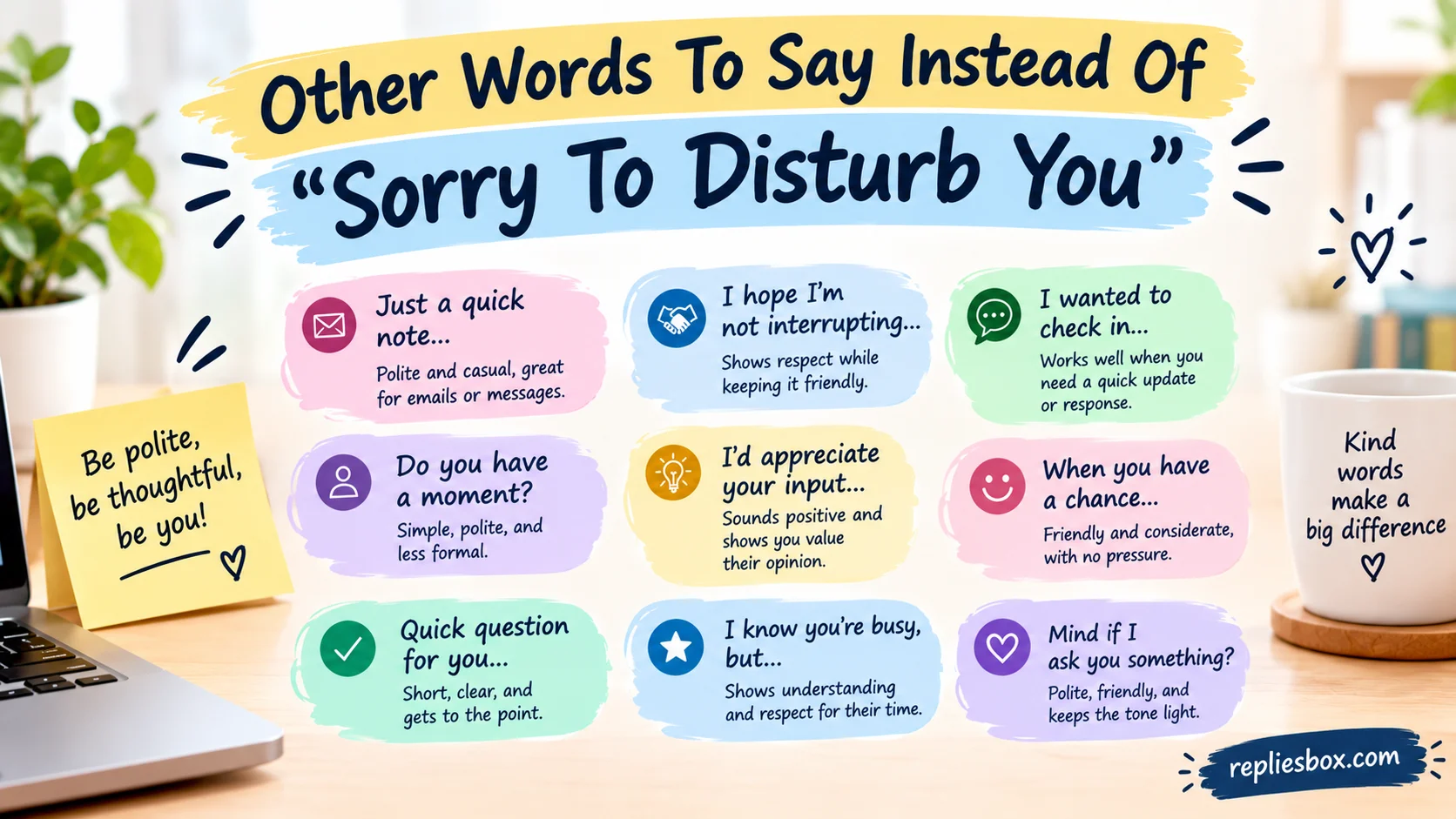
When you need to get someone’s attention, saying “Sorry to disturb you” can sometimes sound more formal or apologetic than necessary. A simple phrase like “Do you have a moment?” or “Can I ask you something?” can feel more natural while still showing respect for the other person’s time.
The best other words to say instead of “Sorry to disturb you” depend on who you are talking to and the situation. A professional conversation may call for a polite and respectful phrase, while a message to a friend can be much more relaxed. If you are interrupting someone who seems busy, it also helps to acknowledge that without making the conversation awkward.
This list brings together natural alternatives for work, texting, friends, formal conversations, and everyday situations. You’ll find simple phrases that let you ask for someone’s attention politely, confidently, and without sounding overly apologetic.
Read More: Heartfelt & Natural Responses to “Happy Thanksgiving to You and Your Family”
Polite Alternatives to “Sorry to Disturb You”
When you need to get someone’s attention but want to remain respectful, a simple polite phrase is usually enough. These alternatives work well when speaking to someone you do not know closely, contacting someone unexpectedly, or starting a conversation that requires their attention.
The goal is to acknowledge that you are interrupting without making the situation sound more serious than it is. A calm phrase can come across as considerate while still sounding confident.
“Excuse me, may I ask you something?”
Meaning
This is a courteous way to approach someone before asking a question. It recognizes their time without sounding overly apologetic.
Tone
Polite, respectful, and direct.
Example
You: Excuse me, may I ask you something?
Person: Sure, what do you need?
Best Use
Use it when speaking to someone unfamiliar, a customer, colleague, employee, or anyone you want to approach respectfully.
“I Hope I’m Not Interrupting”
This phrase is useful when you are unsure whether someone is busy. Instead of assuming they are available, you give them an opportunity to let you know if the timing is inconvenient.
It sounds especially natural when entering an ongoing conversation or starting a phone call.
Meaning
It communicates that you want to speak with someone but respect whatever they may already be doing.
Tone
Considerate, polite, and slightly formal.
Example
You: I hope I’m not interrupting. Do you have a minute?
Colleague: Not at all. What’s up?
Best Use
Use this at work, during a phone call, or whenever you are uncertain whether someone is available.
“Do You Have a Moment?”
Sometimes the best alternative is the simplest one. This question avoids unnecessary apologizing and gets straight to the point.
It also gives the other person a chance to tell you whether they have time.
Meaning
You are politely asking whether the person is available to talk.
Tone
Friendly, respectful, and straightforward.
Example
You: Do you have a moment? I wanted to ask you about the meeting.
Manager: Sure, come in.
Best Use
This works particularly well at work, with acquaintances, and in everyday conversations.
“Can I Quickly Ask You Something?”
When your question will only take a short time, this phrase makes that clear. It can be more natural than apologizing for the interruption.
Meaning
You are asking for brief attention and signaling that you do not intend to take much of the person’s time.
Tone
Casual, polite, and friendly.
Example
You: Can I quickly ask you something?
Friend: Of course.
Best Use
Use it with friends, coworkers, classmates, or people you already know.
Professional Ways to Say “Sorry to Disturb You
Work conversations often call for wording that is respectful without sounding excessively apologetic. If you need to contact a manager, client, coworker, or business professional, a calm request for their time usually works better.
The wording should acknowledge their schedule while making your reason for contacting them clear.
“When you have a moment, could I speak with you?”
Meaning
This tells the person that you need their attention but are willing to wait until they are available.
Tone
Professional, respectful, and considerate.
Example
You: When you have a moment, could I speak with you about the report?
Manager: Yes, I’ll let you know when I’m free.
Best Use
Use this with managers, supervisors, clients, or coworkers when the matter is not urgent.
“Could I Have a Moment of Your Time?”
This is a more formal alternative that works well in professional situations.
It sounds respectful without directly apologizing for approaching the person.
Meaning
You are formally requesting a small amount of someone’s time.
Tone
Professional, courteous, and formal.
Example
You: Could I have a moment of your time?
Supervisor: Certainly. What would you like to discuss?
Best Use
Use it in formal workplace conversations, business settings, or when addressing someone senior to you.
“When You’re Free, Could I Ask You Something?”
This wording is useful when you do not want to pressure someone into responding immediately.
It shows that you are willing to work around their schedule.
Meaning
You need to speak with the person but are happy to wait until they have time.
Tone
Patient, polite, and professional.
Example
You: When you’re free, could I ask you something about the project?
Colleague: Sure, I’ll come by after lunch.
Best Use
Use this when the matter is important but not urgent.
“Could I Trouble You for a Moment?”
This is a more traditional expression and can sound particularly polite in formal conversations.
However, it is slightly old-fashioned, so it may not feel natural in every casual setting.
Meaning
You are politely asking someone to give you a small amount of their time.
Tone
Very polite, formal, and somewhat traditional.
Example
You: Could I trouble you for a moment?
Receptionist: Of course. How can I help?
Best Use
Use it in formal situations when a respectful tone is appropriate.
Friendly Alternatives for Everyday Conversations
With friends, relatives, classmates, or familiar coworkers, you usually do not need a formal apology for starting a conversation. A relaxed phrase can make the interaction feel more natural.
These alternatives work especially well when you simply want to get someone’s attention.
“Hey, Can I Ask You Something?”
Meaning
You are casually asking for the person’s attention before starting your question.
Tone
Friendly, casual, and natural.
Example
You: Hey, can I ask you something?
Friend: Yeah, what’s up?
Best Use
Use it with friends, family, classmates, and people you know well.
“Got a Second?”
This is one of the shortest ways to ask for someone’s attention. It works when you expect the conversation to be brief.
Meaning
You are asking whether the person has a moment to talk.
Tone
Casual, relaxed, and direct.
Example
You: Got a second?
Coworker: Sure. What do you need?
Best Use
Use it with friends and coworkers, especially when the matter is quick.
“Can I Steal a Minute?”
This playful expression does not literally mean taking something. It simply means asking for a little of someone’s time.
Meaning
You want a brief conversation while keeping the request light.
Tone
Friendly, casual, and slightly playful.
Example
You: Can I steal a minute?
Friend: Sure, what’s going on?
Best Use
Use it with people you already know. It is generally too casual for a formal client conversation.
“I Wanted to Run Something by You”
This is a natural phrase when you want someone’s opinion or feedback.
Rather than apologizing for interrupting, you explain why you are approaching them.
Meaning
You want to discuss an idea, question, or decision with someone.
Tone
Casual, professional, and conversational.
Example
You: I wanted to run something by you when you have a minute.
Coworker: Sure, what’s the idea?
Best Use
Great for coworkers, friends, managers, or anyone whose opinion you value.
Short Text Alternatives to “Sorry to Disturb You”
Text messages do not always need a formal apology. If you are messaging someone unexpectedly, a short opening can make the conversation feel polite without sounding stiff.
These options are especially useful when you do not know whether the person is busy.
“Hey, Are You Free for a Minute?”
Meaning
You are checking whether the person is available before continuing.
Tone
Friendly, considerate, and casual.
Example
You: Hey, are you free for a minute?
Friend: Yeah, what’s up?
Best Use
Use it for texting friends, family members, classmates, or coworkers.
“Hope I’m Not Catching You at a Bad Time”
This is a thoughtful alternative when you are contacting someone unexpectedly.
It gives the person an easy way to tell you that they are busy.
Meaning
You are checking whether the timing is convenient.
Tone
Considerate, friendly, and polite.
Example
You: Hope I’m not catching you at a bad time. I had a quick question.
Coworker: No, you’re fine. Go ahead.
Best Use
Use this when calling or messaging someone whose schedule you are unsure about.
“Let Me Know If You’re Busy
This option puts less pressure on the other person. It works particularly well in text messages because the person may not be able to respond immediately.
Meaning
You are making it clear that they do not need to respond right away.
Tone
Considerate, relaxed, and respectful.
Example
You: Hey, I wanted to ask you something. Let me know if you’re busy.
Friend: I’m free right now. What’s up?
Best Use
Use it for texting friends, coworkers, or acquaintances.
Ways to Ask for Attention Without Apologizing
You do not always need to apologize for starting a conversation. In many everyday situations, simply asking whether someone is available sounds more confident and natural.
These expressions work particularly well when you are making a normal request rather than interrupting something important.
“When Would Be a Good Time to Talk?”
Meaning
You are asking the person to choose a convenient time for the conversation.
Tone
Respectful, patient, and professional.
Example
You: When would be a good time to talk about the proposal?
Client: Tomorrow afternoon works for me.
Best Use
Use it for important conversations, workplace matters, appointments, and situations where timing matters.
“Is Now a Good Time?”
This is one of the clearest alternatives because it immediately gives the other person a choice.
Meaning
You are checking whether the person is currently available.
Tone
Direct, polite, and considerate.
Example
You: Is now a good time? I wanted to discuss something with you.
Manager: Yes, go ahead.
Best Use
Use it when the conversation may require more than a few seconds.
“Do You Mind If I Ask You Something?”
This phrase works well when you want to ask a potentially personal, sensitive, or unexpected question.
Meaning
You are asking for permission before bringing up the subject.
Tone
Respectful, careful, and polite.
Example
You: Do you mind if I ask you something?
Friend: No, go ahead.
Best Use
Use it when the question could feel personal or when you want to approach the topic gently.
More Confident Alternatives to “Sorry to Disturb You”
Sometimes saying “sorry” repeatedly can make an ordinary request sound more serious than it is. If you are simply asking someone for information or assistance, a confident opening can be more natural.
“I Need Your Help With Something”
Meaning
You are clearly explaining why you are approaching the person.
Tone
Direct, confident, and respectful.
Example
You: I need your help with something when you have a minute.
Coworker: Sure. What happened?
Best Use
Use it when you genuinely need the person’s assistance and want to get directly to the point.
“I Wanted to Ask You About Something”
This is a simple alternative that avoids unnecessary apologizing.
Meaning
You are introducing the reason for starting the conversation.
Tone
Neutral, polite, and conversational.
Example
You: I wanted to ask you about something from yesterday.
Friend: Sure, what about it?
Best Use
Use it in casual conversations, workplace discussions, or text messages.
“Could I Get Your Opinion on Something?
If you need advice or feedback, explaining that purpose immediately can make the conversation smoother.
Meaning
You are asking for the person’s thoughts rather than simply interrupting them.
Tone
Respectful, collaborative, and friendly.
Example
You: Could I get your opinion on something?
Colleague: Of course. What are you working on?
Best Use
Use it with coworkers, friends, mentors, family members, or anyone whose judgment you trust.
Casual Text Responses Instead of “Sorry to Disturb You”
When sending a casual message, overly formal wording can make the conversation feel unnecessarily serious. A relaxed opening usually works better.
“Hey, Quick Question”
Meaning
You are signaling that you have something brief to ask.
Tone
Casual, friendly, and direct.
Example
You: Hey, quick question—are you coming tonight?
Friend: Yeah, I’ll be there around eight.
Best Use
Use it for texting friends, acquaintances, classmates, and coworkers when the question is simple.
“Whenever You’re Free, I Need to Ask You Something”
This gives the other person room to respond when convenient.
Meaning
You want to talk but are not demanding immediate attention.
Tone
Patient, considerate, and casual.
Example
You: Whenever you’re free, I need to ask you something about the plans.
Friend: I’m free now if you want to talk.
Best Use
Use it when the matter is not urgent and you are comfortable waiting.
Gentle Ways to Interrupt Someone
Sometimes you genuinely have to interrupt because you need information, need to leave, or have something time-sensitive to mention. In those moments, being clear is more useful than over-apologizing.
A short acknowledgment followed by your reason usually works well.
“Excuse Me for a Second”
Meaning
You are briefly interrupting and signaling that you will keep the interruption short.
Tone
Polite, direct, and respectful.
Example
Person A: We were just discussing the schedule—
You: Excuse me for a second. Could you confirm tomorrow’s start time?
Best Use
Use it when you need to briefly interrupt an ongoing conversation.
“May I Interrupt for a Moment?”
This is more formal and directly acknowledges that someone is already speaking or occupied.
Meaning
You are politely requesting permission to interrupt.
Tone
Formal, respectful, and courteous.
Example
You: May I interrupt for a moment? I have an important update.
Speaker: Certainly.
Best Use
Use it in meetings, presentations, formal discussions, or professional settings.
Warm Alternatives for Someone You Know Well
With close friends or family, you can usually drop the formal language altogether. A warm opening can make the conversation feel more personal.
“Hey, I Know You’re Busy, But Can I Talk to You?”
Meaning
You acknowledge that the person may have other things going on while explaining that you would like to speak with them.
Tone
Warm, honest, and considerate.
Example
You: Hey, I know you’re busy, but can I talk to you for a minute?
Sibling: Yeah, what’s wrong?
Best Use
Use this with people you know well, particularly when the conversation is somewhat important.
“Whenever You Have a Minute, Give Me a Call”
Instead of apologizing for contacting someone, you can simply let them choose when to respond.
Meaning
You want to speak with the person but are not asking them to stop what they are doing immediately.
Tone
Relaxed, considerate, and practical.
Example
You: Whenever you have a minute, give me a call. I wanted to discuss the plans.
Friend: Sure, I’ll call you later.
Best Use
Use it for phone calls, text messages, family conversations, and casual workplace communication.
How to Choose the Right Alternative
The best replacement for “Sorry to disturb you” depends less on the exact words and more on the situation. A phrase that sounds natural with a friend may feel too casual with a manager, while a formal expression can sound stiff in a text message.
Think about three things before choosing your wording: who you are talking to, how urgent the matter is, and how formal the situation is. If you are unsure, “Do you have a moment?” is a safe choice because it is polite without sounding overly formal.
For professional situations, phrases such as “When you have a moment, could I speak with you?” work well. With friends, “Hey, can I ask you something?” feels more natural. If you are texting someone who may be busy, “Whenever you’re free, I wanted to ask you something” gives them plenty of room to respond.
Meaning
The right phrase shows consideration for the other person’s time while still allowing you to communicate clearly.
Tone
The tone can range from casual and friendly to formal and professional depending on your choice.
Example
You: I need to ask my manager something, but I don’t want to interrupt her meeting.
Coworker: You could just say, “When you have a moment, could I speak with you?”
Best Use
Use the level of formality that matches your relationship and the setting rather than automatically choosing the most apologetic phrase.
Frequently Asked Questions
What can I say instead of “Sorry to disturb you”?
You can say “Excuse me,” “Do you have a moment?” “I hope I’m not interrupting,” or “Can I quickly ask you something?” The best choice depends on how formal the situation is.
What is a polite alternative to “Sorry to disturb you”?
“I hope I’m not interrupting” and “When you have a moment, could I speak with you?” are polite options that show consideration without sounding overly apologetic.
What is a casual way to say “Sorry to disturb you”?
With friends or familiar coworkers, try “Hey, can I ask you something?”, “Got a second?”, or “Quick question.”
How can I say it professionally?
For work situations, you can say “Could I have a moment of your time?”, “When you have a moment, could I speak with you?”, or “Is now a good time?”
What should I say in a text message?
Keep it natural and brief. “Hey, are you free for a minute?”, “Hope I’m not catching you at a bad time,” or “Whenever you’re free, I wanted to ask you something” are good options.
Is it necessary to apologize when interrupting someone?
Not always. If you are making a normal request, simply asking whether the person is available can sound more confident. An apology is more appropriate when you have genuinely interrupted something important or inconvenienced someone.
Conclusion
There are plenty of natural other words to say instead of “Sorry to Disturb You,” and the best one depends on the person, setting, and reason for contacting them. A simple “Do you have a moment?” works in many situations, while professional conversations may call for something more formal. With friends, a relaxed “Hey, can I ask you something?” often sounds more natural.
The main thing is not to overthink the wording. Be respectful, make your purpose clear, and give the other person room to respond when they are available. When your phrase matches the situation, you can get someone’s attention without making a simple conversation feel unnecessarily awkward.














5 thoughts on “25 Other Words to Say Instead of “Sorry to Disturb You” for Any Situation”