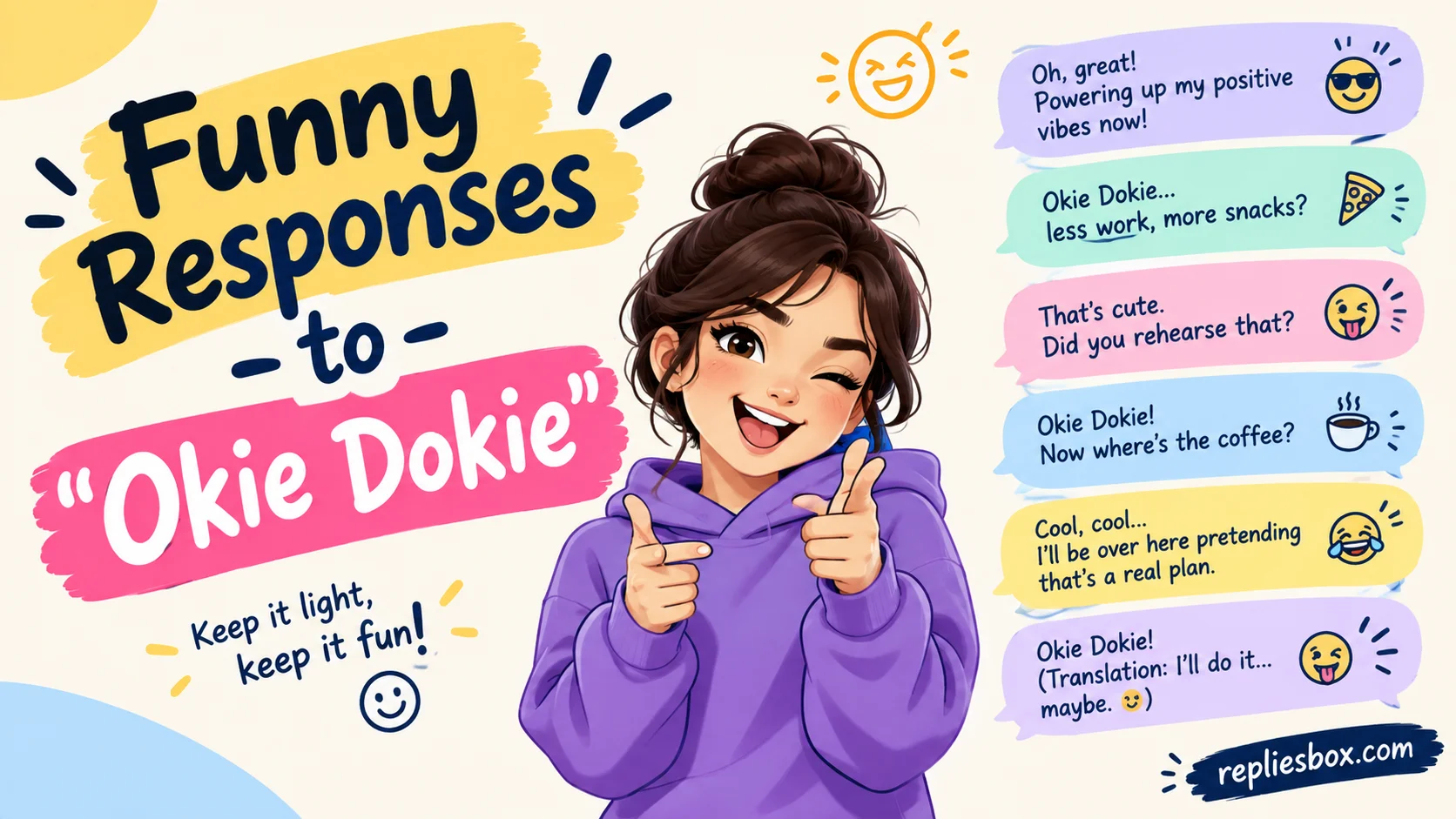
“Okie dokie” is one of those casual phrases that can make a conversation feel light and easy. But when someone sends it in a text, you might want to answer with something more fun than a simple “okay.” A quick joke, playful comeback, or clever twist can keep the conversation going and show a little personality.
The best funny responses to “Okie Dokie” depend on who you’re talking to and the mood of the conversation. With a close friend, you can be silly or sarcastic. With someone you’re getting to know, a lighter reply usually works better. The goal is to make them smile without making the response feel forced.
From short and goofy replies to witty comebacks and playful messages, the ideas below give you plenty of ways to respond naturally. Pick one that sounds like something you would actually say, or use the examples as inspiration to create your own.
Read More: Different Ways to Say “I Just Arrived”
Funny Responses to “Okie Dokie”
When someone says “okie dokie” in a relaxed conversation, you can answer with something equally lighthearted. These replies work best when the conversation already has a playful tone, so your response feels like natural banter rather than a rehearsed joke.
“Okie dokie, artichokie!”
Meaning: You are playfully rhyming with their phrase and adding a silly twist.
Tone: Funny, playful, goofy.
Example
Friend: I’ll meet you at seven.
You: Okie dokie, artichokie!
Best Use
Great for friends, siblings, casual texting, or anyone who enjoys silly wordplay.
“Roger that, potato.”
Meaning: You are pretending to acknowledge their message in an unnecessarily dramatic way.
Tone: Absurd, playful, casual.
Example
Friend: Don’t forget to bring the snacks.
You: Roger that, potato.
Best Use
Works particularly well in a casual text conversation where both people joke around.
“Copy that, captain.”
Meaning: You are treating their simple “okie dokie” like an official command.
Tone: Playful, exaggerated, humorous.
Example
Friend: Be ready by eight.
You: Copy that, captain.
Best Use
Use it when you want to make an ordinary conversation sound dramatically important.
Playful Comebacks for a Friend
Friends often give you more room to be ridiculous. If “okie dokie” is part of an informal conversation, exaggerating the phrase or pretending it has enormous significance can make the exchange funnier.
“That’s the spirit!”
Meaning: You are jokingly celebrating their very ordinary agreement.
Tone: Cheerful, teasing, light.
Example
Friend: Okie dokie.
You: That’s the spirit! I knew we’d get there eventually.
Best Use
Good for friends when you want a humorous reaction without being sarcastic.
“Excellent. The mission is underway.”
Meaning: You are turning their simple agreement into a dramatic mission briefing.
Tone: Funny, theatrical, playful.
Example
Friend: Okie dokie, I’ll bring the drinks.
You: Excellent. The mission is underway.
Best Use
Especially fun in group chats or conversations involving plans.
“And just like that, we have a deal.”
Meaning: You are humorously treating their casual agreement like a formal negotiation.
Tone: Clever, playful, slightly dramatic.
Example
Friend: Okie dokie, you can have the last slice.
You: And just like that, we have a deal.
Best Use
Perfect when the conversation involves a small agreement or favor.
Short Funny Replies to “Okie Dokie”
Sometimes the best comeback is only a few words. Short replies are particularly useful in texting because they keep the same quick rhythm as the original message.
“Dokie noted.”
Meaning: A deliberately silly variation of “noted.”
Tone: Short, goofy, casual.
Example
Friend: Okie dokie.
You: Dokie noted.
Best Use
Use it when you want a quick joke without extending the conversation.
“Very dokie.”
Meaning: You are humorously treating “okie dokie” as though it can be measured.
Tone: Dry, silly, understated.
Example
Friend: Okie dokie!
You: Very dokie.
Best Use
Good for friends who appreciate deadpan humor.
“Okie dokie approved.”
Meaning: You are pretending their message has officially received authorization.
Tone: Playful, mock-formal.
Example
Friend: I’ll send it tonight.
You: Okie dokie approved.
Best Use
Works nicely in texting when you want a short, harmless joke.
Clever Replies When You Want to Keep the Banter Going
A clever response does not necessarily need to be a joke with a punchline. Sometimes simply twisting the wording is enough to give the conversation personality.
“That sounded suspiciously cheerful.”
Meaning: You are teasing them about their upbeat way of agreeing.
Tone: Witty, teasing, conversational.
Example
Friend: Okie dokie!
You: That sounded suspiciously cheerful.
Best Use
Best with friends or people you already know well.
“I appreciate the enthusiasm.”
Meaning: You are humorously exaggerating how enthusiastic their simple response sounded.
Tone: Dry, playful, lightly sarcastic.
Example
Friend: Okie dokie.
You: I appreciate the enthusiasm.
Best Use
A good choice when you want subtle humor rather than a loud joke.
“That’s an oddly adorable way to agree.”
Meaning: You are commenting playfully on the cute sound of “okie dokie.”
Tone: Warm, playful, slightly affectionate.
Example
Friend: Okie dokie, see you later.
You: That’s an oddly adorable way to agree.
Best Use
Works best with someone you’re comfortable teasing.
Silly Responses to “Okie Dokie”
If your conversation is already ridiculous, lean into it. These responses intentionally make the exchange more absurd rather than trying to sound clever.
“Okie dokie, broccoli!”
Meaning: You are extending the rhyme with another playful food word.
Tone: Goofy, cheerful, silly.
Example
Friend: Okie dokie.
You: Okie dokie, broccoli!
Best Use
Best among friends, children, siblings, or anyone who enjoys deliberately corny humor.
“Understood, your dokieness.”
Meaning: You are inventing a mock title based on “okie dokie.”
Tone: Absurd, theatrical, playful.
Example
Friend: Okie dokie, I’ll handle it.
You: Understood, your dokieness.
Best Use
Use this when you want a deliberately ridiculous response.
“The dokie has been accepted.”
Meaning: You are pretending that their casual response has gone through an official approval process.
Tone: Deadpan, absurd, humorous.
Example
Friend: Okie dokie.
You: The dokie has been accepted.
Best Use
Great for group chats and silly conversations.
Sarcastic Replies to “Okie Dokie”
Sarcasm can be funny, but it depends heavily on the relationship. A close friend may understand the joke immediately, while a coworker or new acquaintance might read it as irritation.
“Wow, such detailed feedback.”
Meaning: You are joking about how little information “okie dokie” provides.
Tone: Dry, sarcastic, teasing.
Example
Friend: Okie dokie.
You: Wow, such detailed feedback.
Best Use
Best with friends who already understand your sarcastic humor.
“I’ll treasure that response forever.”
Meaning: You are humorously pretending their simple acknowledgment was deeply meaningful.
Tone: Dramatic, sarcastic, playful.
Example
Friend: Okie dokie.
You: I’ll treasure that response forever.
Best Use
Use it when you want exaggerated sarcasm without sounding genuinely annoyed.
“Your eloquence is truly inspiring.”
Meaning: You are pretending that “okie dokie” was an exceptionally sophisticated answer.
Tone: Dry, sarcastic, witty.
Example
Friend: Okie dokie.
You: Your eloquence is truly inspiring.
Best Use
Better for close friends than formal or unfamiliar relationships.
Flirty Responses to “Okie Dokie”
If the conversation has a mutual romantic or teasing tone, you can turn “okie dokie” into a playful opening for flirtation. Keep the response light unless you already know the other person is comfortable with that kind of banter.
“That ‘okie dokie’ was kinda cute.”
Meaning: You are turning their casual wording into a small compliment.
Tone: Flirty, warm, playful.
Example
Them: Okie dokie, see you tonight.
You: That “okie dokie” was kinda cute.
Best Use
Suitable for someone you’re already flirting with rather than a stranger or coworker.
“Okay, now say it again. That was adorable.”
Meaning: You are playfully asking them to repeat their cute expression.
Tone: Flirty, teasing, affectionate.
Example
Them: Okie dokie.
You: Okay, now say it again. That was adorable.
Best Use
Use when there is already clear mutual flirtation.
“Okie dokie? You’re making it hard not to smile.”
Meaning: You are turning their casual phrase into a charming compliment.
Tone: Soft, flirty, affectionate.
Example
Them: Okie dokie, I’ll text you later.
You: Okie dokie? You’re making it hard not to smile.
Best Use
Best in a warm personal conversation where flirting is already welcome.
Professional-Friendly Responses to “Okie Dokie”
“Okie dokie” is generally informal, so a professional response does not need to imitate its playful style. If a coworker uses it casually, a simple acknowledgment can keep the exchange friendly without becoming overly familiar.
“Sounds good!”
Meaning: You are confirming that you understand and agree.
Tone: Friendly, professional, straightforward.
Example
Coworker: Okie dokie, I’ll send the file this afternoon.
You: Sounds good!
Best Use
Ideal for casual workplace chats, email threads with an informal tone, or messages between familiar coworkers.
“Got it—thanks!”
Meaning: You acknowledge the message while keeping the conversation efficient.
Tone: Polite, concise, professional.
Example
Coworker: Okie dokie, the meeting is moved to three.
You: Got it—thanks!
Best Use
Useful when you do not want to extend the conversation.
Funny Text Responses to “Okie Dokie”
Texting gives you room for quick wordplay because the conversation is already informal. A good text response should usually be short enough to feel spontaneous.
“Okie dokie, message received loud and dokie.”
Meaning: You are deliberately playing with the sound of the phrase.
Tone: Goofy, casual, humorous.
Example
Friend: Okie dokie, I’ll be there.
You: Okie dokie, message received loud and dokie.
Best Use
Great for casual texting with friends.
“Acknowledged by the Department of Dokie Affairs.”
Meaning: You are inventing a ridiculous official department to make the response funny.
Tone: Absurd, clever, playful.
Example
Friend: Okie dokie, I’ll bring dessert.
You: Acknowledged by the Department of Dokie Affairs.
Best Use
Especially suitable for friends who enjoy exaggerated, nonsensical humor.
Cute Responses to “Okie Dokie”
Sometimes you want to match the sweetness of the phrase rather than make fun of it. These replies are gentle and work well when the conversation is affectionate.
“Okie dokie, you adorable human.”
Meaning: You are responding with a playful compliment.
Tone: Cute, warm, affectionate.
Example
Friend: Okie dokie, I’ll see you soon.
You: Okie dokie, you adorable human.
Best Use
Good for close friends, siblings, or someone you have a warm relationship with.
“Deal, you little goofball.”
Meaning: You are accepting the agreement while adding friendly teasing.
Tone: Affectionate, playful, casual.
Example
Friend: Okie dokie, it’s a deal.
You: Deal, you little goofball.
Best Use
Best when playful teasing is already normal between you.
Responses That Turn “Okie Dokie” Into a Joke
If the other person repeatedly says “okie dokie,” you can make the phrase itself the subject of the joke. This works particularly well in an ongoing conversation.
“At this point, ‘okie dokie’ is basically your catchphrase.”
Meaning: You are joking about how frequently they use the phrase.
Tone: Observational, playful, teasing.
Example
Friend: Okie dokie.
You: At this point, “okie dokie” is basically your catchphrase.
Best Use
Use it when the person genuinely uses the expression often.
“I see we’re bringing the full dokie energy today.”
Meaning: You are inventing a humorous concept around their wording.
Tone: Silly, casual, playful.
Example
Friend: Okie dokie!
You: I see we’re bringing the full dokie energy today.
Best Use
Good for relaxed conversations and group chats.
When “Okie Dokie” Sounds Dismissive
Although “okie dokie” is often friendly, context matters. A very short response after a serious message can sometimes feel like the person is brushing the conversation aside. Before responding sarcastically, consider whether they are simply being casual or actually trying to end the discussion.
“Okay, I’ll take that as a very enthusiastic maybe.”
Meaning: You gently tease them while leaving room for clarification.
Tone: Light, mildly sarcastic, conversational.
Example
You: Can you let me know if you’re coming?
Them: Okie dokie.
You: Okay, I’ll take that as a very enthusiastic maybe.
Best Use
Useful when you genuinely need a clearer answer but want to keep the tone light.
Confident Comebacks When Someone Uses “Okie Dokie” Too Casually
If someone responds to a serious or detailed request with “okie dokie,” a humorous comeback can point out the mismatch without turning the exchange into an argument.
“Glad we settled this historic matter.”
Meaning: You are jokingly exaggerating the importance of the agreement.
Tone: Dry, confident, playful.
Example
Friend: Okie dokie, I’ll stop stealing your fries.
You: Glad we settled this historic matter.
Best Use
Works well when the original conversation involves a small disagreement or agreement.
“Perfect. I’ll file that under ‘officially handled.’”
Meaning: You are humorously treating their response as an official confirmation.
Tone: Confident, witty, lightly sarcastic.
Example
Friend: Okie dokie, I’ll take care of it.
You: Perfect. I’ll file that under “officially handled.”
Best Use
Good for casual conversations where you want to sound amused rather than demanding.
Funny Replies When You Want to End the Conversation
Not every reply needs to keep the conversation going. Sometimes a humorous closing line lets both people move on naturally.
“Okie dokie. Go forth and conquer.”
Meaning: You are giving an exaggerated send-off for an ordinary task.
Tone: Encouraging, funny, theatrical.
Example
Friend: Okie dokie, I’m heading out.
You: Okie dokie. Go forth and conquer.
Best Use
Works well when a friend is leaving, starting a task, or heading somewhere.
“Dokie out.”
Meaning: You are turning “okie dokie” into a playful sign-off.
Tone: Short, silly, casual.
Example
Friend: Okie dokie, talk later.
You: Dokie out.
Best Use
Ideal for quick texts when you want a deliberately goofy ending.
How to Choose the Right Funny Response
The funniest response is not always the most ridiculous one. Context matters more than the joke itself. If a close friend sends “okie dokie,” you can usually get away with exaggerated sarcasm, silly rhymes, or absurd one-liners. With a coworker, a simple “Sounds good!” may be more appropriate even if you personally find “okie dokie” funny.
Pay attention to the person’s usual communication style too. Someone who constantly jokes may enjoy a dramatic comeback, while someone who keeps messages short may prefer a quick response. If you’re unsure, choose a playful reply that does not depend on sarcasm. That keeps the conversation light without creating unnecessary confusion.
Quick tip: Humor usually lands better when you match the other person’s energy instead of trying to outdo it.
Funny Responses for Group Chats
Group chats are a good place for exaggerated replies because several people can build on the joke. A response such as “The council has accepted the dokie” can become part of the group’s running humor.
“The council has spoken.”
Meaning: You are jokingly treating their “okie dokie” as an official decision.
Tone: Dramatic, funny, playful.
Example
Friend: Okie dokie, pizza at eight.
You: The council has spoken.
Best Use
Great for group chats where everyone is already joking around.
“Noted. The dokie committee will proceed.”
Meaning: You are inventing an imaginary committee to make a normal acknowledgment ridiculous.
Tone: Absurd, mock-formal, humorous.
Example
Friend: Okie dokie, I’ll bring the drinks.
You: Noted. The dokie committee will proceed.
Best Use
Best for group conversations with an established playful atmosphere.
What to Avoid When Replying to “Okie Dokie
A funny comeback can quickly stop being funny if it ignores the context. Avoid heavy sarcasm when you are speaking to someone you barely know, especially if their “okie dokie” was simply a friendly acknowledgment. Text also removes facial expressions and vocal cues, so jokes that sound obvious in person can sometimes look genuinely irritated on a screen.
It is also better to avoid forcing a joke when the other person is discussing something serious. If they use “okie dokie” after an important conversation, a straightforward response may be more respectful. Humor works best when it adds warmth rather than making the other person feel dismissed.
Better choice: When you’re uncertain, use a light response such as “Sounds good!” and save the bigger jokes for people who already understand your sense of humor.
Frequently Asked Questions
What is a funny response to “Okie Dokie”?
A funny response can be as simple as “Okie dokie, artichokie!”, “Very dokie,” or “The dokie has been accepted.” Choose based on how playful the conversation already is.
Is “Okie dokie” a friendly phrase?
Usually, yes. “Okie dokie” is generally an informal and playful way of saying “okay.” However, its meaning can depend on context, especially if it follows a serious message.
What is a good short reply to “Okie Dokie”?
For a quick response, try “Dokie noted,” “Very dokie,” “Sounds good!”, or “Copy that, captain.” The first two are more playful, while “Sounds good!” is safer in everyday conversation.
Can I use a sarcastic response to “Okie Dokie”?
Yes, if the relationship supports sarcasm. A line such as “Wow, such detailed feedback” can be funny between close friends but may sound annoyed when used with someone who does not know your humor.
What should I say if “Okie Dokie” feels dismissive?
If you need clarification, keep the response light but direct. For example, “Okay, but are we actually agreed?” or “I’ll take that as a yes—just confirming.” This avoids guessing what the person meant.
Is “Okie Dokie” appropriate at work?
It can appear in relaxed workplace conversations, especially between coworkers who communicate casually. In formal emails, meetings, or messages involving clients, a straightforward phrase such as “Understood,” “Sounds good,” or “Thanks, noted” is usually clearer.
Conclusion
The best funny responses to “Okie Dokie” are the ones that fit the relationship and the moment. A silly rhyme can work perfectly with a close friend, while a subtle joke may be better for a casual acquaintance. If the conversation is flirty, playful teasing can add warmth; if it is professional, keeping things simple is usually more appropriate.
When in doubt, match the other person’s energy and avoid sarcasm that could be misunderstood over text. A response does not need to be complicated to be funny. Sometimes “Very dokie” or “The council has spoken” is enough to turn an ordinary message into a memorable little exchange.
Available next action: Create a downloadable DOCX file here in this chat containing the editable prose above














3 thoughts on “25 Funny Responses to “Okie Dokie” That Keep the Conversation Playful”