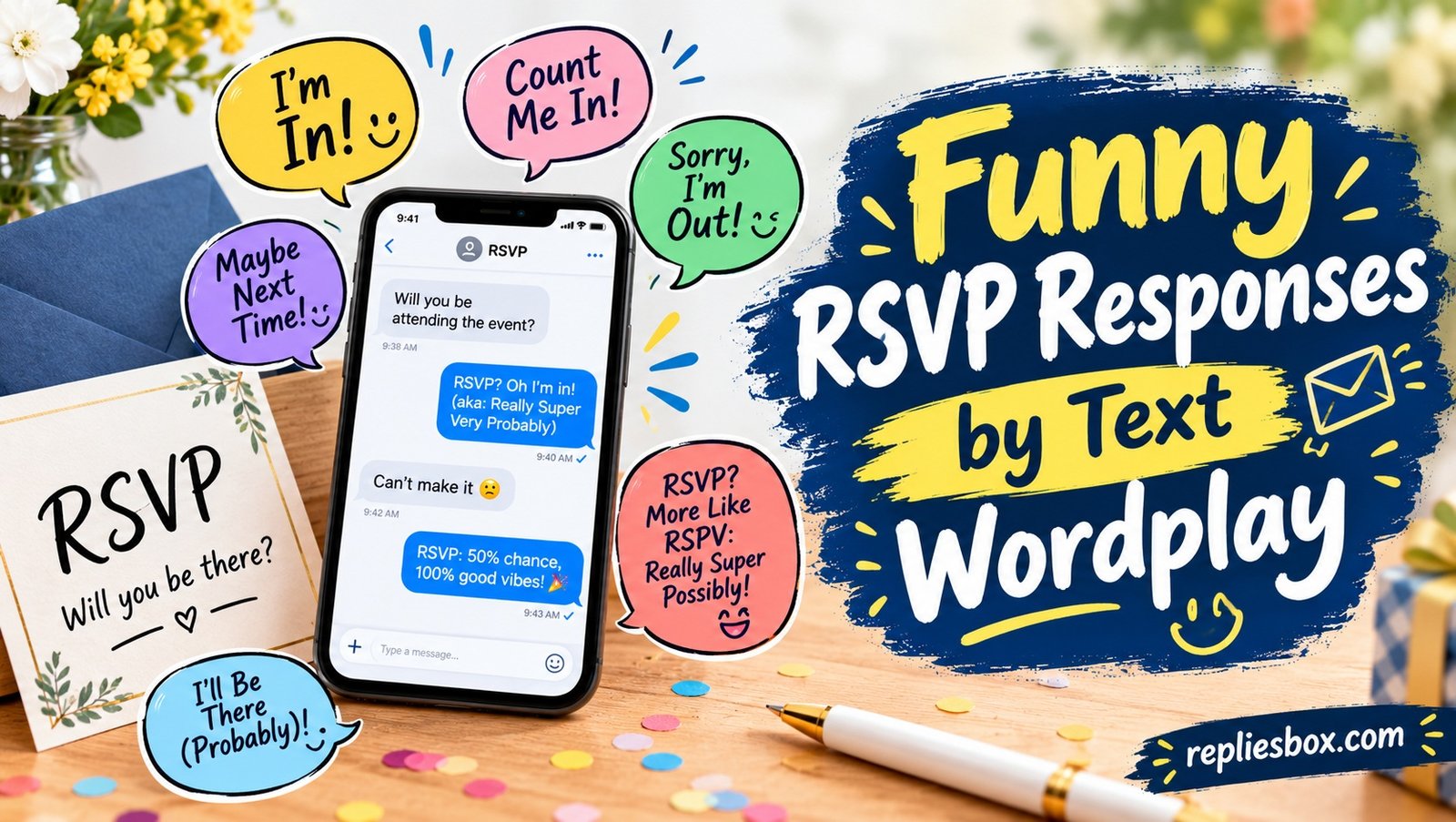
An RSVP doesn’t have to be a plain “Yes” or “No.” A little humor can make your reply more memorable, whether you’re invited to a birthday party, a wedding, a dinner, or a weekend get-together. The right joke can show you’re excited to attend or make a polite decline feel less awkward.
These funny RSVP responses by text give you natural ways to accept an invitation, say you can’t make it, or tease your friends without sounding rude. From witty one-liners to playful excuses, there’s something for different occasions and personalities.
The key is to match your reply to the person inviting you and the event itself. A sarcastic message might work with close friends, while a warm, lighthearted response is better for formal occasions. Choose a line that sounds like you, make your answer clear, and let the humor come naturally.
Read More: 25 Natural Ways to Say “Let Me Know If Otherwise” for Clear, Polite Communication
Funny RSVP Responses When You’re Accepting an Invitation
When you plan to attend, your RSVP is a chance to show enthusiasm while adding a little personality. These replies work especially well for friends, siblings, cousins, and people who appreciate a good joke. You can tease yourself about your dancing, your appetite, or your ability to turn up wherever snacks are served. For formal events, keep the humor gentle and make sure your answer clearly confirms that you’re coming.
1. “Count me in—I heard there might be food.”
Meaning: You’re accepting the invitation, with a playful suggestion that the menu helped make your decision.
Tone: Funny, casual, and friendly.
Example:
Friend: Are you coming to the birthday party on Saturday?
You: Count me in—I heard there might be food.
Best Use: Birthday parties, dinner invitations, and casual gatherings with friends.
2. “Absolutely! Prepare the snacks and hide the karaoke machine.”
Meaning: You’re excited to attend and jokingly warning the host about your party behavior.
Tone: Playful and energetic.
Example:
Cousin: We’re having a family get-together this weekend. Can you come?
You: Absolutely! Prepare the snacks and hide the karaoke machine.
Best Use: Family parties or gatherings where everyone enjoys a little silliness.
3. “Yes! My social calendar has finally found a purpose.”
Meaning: You’re happy to have something fun planned.
Tone: Witty and lightly sarcastic.
Example:
Friend: Game night at my place Friday. You in?
You: Yes! My social calendar has finally found a purpose.
Best Use: Casual invitations from friends who understand your sense of humor.
4. “I’ll be there, dressed like I made an effort.”
Meaning: You’re confirming your attendance while poking fun at your usual casual style.
Tone: Self-deprecating and humorous.
Example:
Friend: Don’t forget to dress nicely for dinner.
You: I’ll be there, dressed like I made an effort.
Best Use: Informal dinners, birthday celebrations, and outings with close friends.
5. “Yes, and I promise to limit my embarrassing dance moves.”
Meaning: You’re accepting and joking about being the entertainment.
Tone: Cheerful and teasing.
Example:
Friend: Are you joining us for the wedding reception?
You: Yes, and I promise to limit my embarrassing dance moves.
Best Use: Weddings, parties, and events where dancing is expected.
Hilarious RSVP Replies for Friends
Friends are usually the easiest people to joke with because they already know your personality. A funny RSVP can turn a routine invitation into the start of a playful conversation. These responses lean into familiar habits, dramatic reactions, and friendly exaggeration. Just make sure your joke doesn’t sound like you’re mocking the event or the person hosting it. If your friend is organizing something important, add a clear yes or no so they don’t have to guess what you mean.
6. “I’m in. Please add me to the official list of legends.”
Meaning: You’re accepting with exaggerated confidence.
Tone: Cheeky and playful.
Example:
Friend: Who’s coming over for movie night?
You: I’m in. Please add me to the official list of legends.
Best Use: Group chats, movie nights, game nights, and casual hangouts.
7. “Yes, I shall grace this gathering with my presence.”
Meaning: You’re making an ordinary acceptance sound hilariously grand.
Tone: Dramatic and mock-formal.
Example:
Friend: Can you make it to dinner tonight?
You: Yes, I shall grace this gathering with my presence.
Best Use: Friends who enjoy dramatic jokes and exaggerated language.
8. “Finally, an invitation worthy of leaving my couch.”
Meaning: You’re joking that the event is exciting enough to get you out of the house.
Tone: Sarcastic but friendly.
Example:
Friend: We’re going bowling this weekend. Interested?
You: Finally, an invitation worthy of leaving my couch.
Best Use: Invitations from close friends who know you’re joking about being comfortable at home.
9. “Yes. I have nothing planned except pretending to be busy.”
Meaning: You’re playfully admitting that your schedule is wide open.
Tone: Dry and self-deprecating.
Example:
Friend: Want to grab coffee tomorrow?
You: Yes. I have nothing planned except pretending to be busy.
Best Use: Casual coffee dates, lunch plans, and spontaneous meetups.
10. “Put me down as a definite maybe—just kidding, I’m coming!”
Meaning: You briefly create suspense before making your answer clear.
Tone: Lighthearted and teasing.
Example:
Friend: I need a final head count for Saturday.
You: Put me down as a definite maybe—just kidding, I’m coming!
Best Use: Friendly group chats and informal events where your attendance needs to be confirmed.
Funny RSVP Responses When You Can’t Attend
Declining an invitation can feel awkward, especially when you like the person but genuinely can’t make it. Humor can soften the disappointment without making the host feel unimportant. The safest approach is to state that you can’t attend, then add a lighthearted line about your schedule, responsibilities, or wish to be there. Avoid making jokes that sound like you’re glad to miss the event, particularly if it’s a wedding, milestone birthday, or another meaningful occasion.
11. “Sadly, my calendar has betrayed me.”
Meaning: You’re declining because of a scheduling conflict, using a playful metaphor.
Tone: Funny and mildly dramatic.
Example:
Friend: Can you come to dinner on Thursday?
You: Sadly, my calendar has betrayed me. I can’t make it this time.
Best Use: Casual invitations when you have a genuine scheduling conflict.
12. “I’d love to, but my couch has filed a formal complaint.”
Meaning: You’re joking about being tempted to stay home, while still declining.
Tone: Silly and relaxed.
Example:
Friend: We’re having a movie marathon tonight. Want to join?
You: I’d love to, but my couch has filed a formal complaint. Rain check?
Best Use: Close friends and low-pressure social plans. Don’t use it if the host might take your absence personally.
13. “My attendance has been denied by the department of responsibilities.”
Meaning: Your obligations are keeping you away.
Tone: Mock-official and witty.
Example:
Coworker: We’re grabbing lunch after work. Are you coming?
You: My attendance has been denied by the department of responsibilities. I’ve got to finish something today.
Best Use: Friendly coworkers and casual social invitations.
14. “I’ll be there in spirit—and possibly through a very jealous text.”
Meaning: You can’t attend, but you’ll be thinking about the fun everyone is having.
Tone: Warm and humorous.
Example:
Friend: We’re all meeting up for dinner Saturday.
You: I can’t make it, but I’ll be there in spirit—and possibly through a very jealous text.
Best Use: Friend gatherings, casual celebrations, and events you wish you could attend.
15. “I regret to inform you that my schedule is being dramatic again.”
Meaning: You’re unavailable and using humor to describe your busy schedule.
Tone: Playful and slightly sarcastic.
Example:
Friend: Are you free for brunch on Sunday?
You: I regret to inform you that my schedule is being dramatic again. I can’t make brunch this week.
Best Use: Friends who enjoy joking about everyday inconveniences.
Short and Witty RSVP Texts
Sometimes the best response is one quick line. Short RSVP messages are ideal when the invitation arrives by text and the conversation is already casual. They give the host a clear answer without turning a simple exchange into a long performance. A compact joke can work particularly well in a group chat, where people are replying quickly. If the invitation involves a formal event or requires a firm head count, make sure your message includes an unmistakable acceptance or decline.
16. “Yes. Let the shenanigans begin.”
Meaning: You’re happily accepting and expecting a good time.
Tone: Energetic and playful.
Example:
Friend: Party at mine Saturday. Are you in?
You: Yes. Let the shenanigans begin.
Best Use: Parties, casual celebrations, and friends’ group chats.
17. “I’m a yes with snacks on my mind.”
Meaning: You’re accepting and humorously mentioning your priorities.
Tone: Cute and funny.
Example:
Friend: Brunch at noon?
You: I’m a yes with snacks on my mind.
Best Use: Brunches, picnics, potlucks, and food-centered gatherings.
18. “Confirmed. Please clap.”
Meaning: You’re giving a definite answer with mock-ceremonial flair.
Tone: Dry and concise.
Example:
Friend: Can I count you in for game night?
You: Confirmed. Please clap.
Best Use: Informal invitations with people who understand deadpan humor.
19. “Hard yes. Soft dancing.”
Meaning: You’re definitely attending but making no promises about your dancing ability.
Tone: Clever and playful.
Example:
Friend: You’re coming to the wedding, right?
You: Hard yes. Soft dancing.
Best Use: Weddings, parties, and events with music or dancing.
20. “Nope, but my heart RSVP’d yes.”
Meaning: You can’t attend, but you’re sending warm wishes.
Tone: Sweet and humorous.
Example:
Friend: Can you make it to my birthday dinner?
You: Nope, but my heart RSVP’d yes. I hope you have the best time!
Best Use: Friendly invitations when you want to decline affectionately.
Funny RSVP Responses for Birthday Parties
Birthday invitations often call for a little extra enthusiasm. Whether it’s a small dinner or a big celebration, your reply can match the birthday person’s personality and the kind of party they’re planning. A joke about cake, candles, or getting older works best when you know the person won’t mind. If the birthday is a sensitive milestone, avoid age-related humor unless you’re certain it’s welcome. The goal is to make the host smile while still answering the invitation clearly.
21. “Yes! I’ll arrive ready to support the cake industry.”
Meaning: You’re attending and joking that dessert is a major attraction.
Tone: Funny and enthusiastic.
Example:
Friend: Birthday cake at my place Saturday. Coming?
You: Yes! I’ll arrive ready to support the cake industry.
Best Use: Birthday parties, cake-cutting celebrations, and casual gatherings.
22. “Absolutely. Someone needs to sing happy birthday off-key.”
Meaning: You’re accepting and volunteering for a deliberately questionable musical performance.
Tone: Silly and self-deprecating.
Example:
Sibling: We’re surprising Mom for her birthday. Are you coming?
You: Absolutely. Someone needs to sing happy birthday off-key.
Best Use: Family birthdays and celebrations with a relaxed atmosphere.
23. “Yes, but I reserve the right to ask for a second slice.”
Meaning: You’re confirming your attendance while joking about your appetite.
Tone: Lighthearted and cheeky.
Example:
Friend: Birthday dinner next Friday. Can you come?
You: Yes, but I reserve the right to ask for a second slice.
Best Use: Birthday dinners and celebrations where food is part of the fun.
Playful RSVP Replies for Weddings and Formal Events
Weddings and formal celebrations can still leave room for humor, but your reply should respect the occasion. A joke about dancing, dressing up, or getting emotional is usually safer than anything that pokes fun at the couple, their relationship, or the cost of the event. Keep your RSVP clear because hosts often need accurate numbers for seating and catering. If the invitation requests a specific response format, follow it first and save the joke for a personal message.
24. “Yes! I’ll bring my best outfit and my average dance moves.”
Meaning: You’re accepting while poking fun at your dancing skills.
Tone: Warm and playful.
Example:
Friend: We’d love to have you at our wedding reception!
You: Yes! I’ll bring my best outfit and my average dance moves.
Best Use: Wedding invitations from friends or relatives who appreciate light humor.
25. “Confirmed. Emotionally preparing for the speeches.”
Meaning: You’re attending and joking that the heartfelt moments might get to you.
Tone: Affectionate and gently funny.
Example:
Cousin: Are you coming to the wedding next month?
You: Confirmed. Emotionally preparing for the speeches.
Best Use: Weddings and engagement celebrations, especially among family and close friends.
26. “Yes, and I’ll try not to outshine the centerpieces.”
Meaning: You’re playfully pretending you’ll be the star of the event.
Tone: Cheeky and theatrical.
Example:
Friend: Please RSVP for the engagement party.
You: Yes, and I’ll try not to outshine the centerpieces.
Best Use: Informal engagement parties and celebrations with close friends.
Funny RSVP Replies for Group Chats
Group chats are perfect for quick jokes because the invitation often comes with a stream of reactions, memes, and playful teasing. You can make your answer stand out without writing a whole paragraph. Still, don’t let a joke create confusion when someone is organizing transport, booking a table, or collecting contributions. A funny line followed by a clear confirmation is usually the best combination. These responses work especially well when the group already has a relaxed, joking dynamic.
27. “I’m in. Someone has to keep this group moderately organized.”
Meaning: You’re accepting and teasing your friends about their chaotic plans.
Tone: Friendly and mock-responsible.
Example:
Friend: Everyone, confirm if you’re coming on Saturday.
You: I’m in. Someone has to keep this group moderately organized.
Best Use: Group outings, road trips, game nights, and casual meetups.
28. “Yes. I expect a commemorative group photo.”
Meaning: You’re accepting and joking that the occasion deserves documentation.
Tone: Lighthearted and playful.
Example:
Friend: We’re finally getting everyone together this weekend.
You: Yes. I expect a commemorative group photo.
Best Use: Reunions, friend gatherings, and group celebrations.
29. “I’m coming. Please update the group chat’s historical records.”
Meaning: You’re making your attendance sound like a major event.
Tone: Dramatic and dryly funny.
Example:
Friend: Wait, you’re actually free on Friday?
You: I’m coming. Please update the group chat’s historical records.
Best Use: Groups where your schedule is famously difficult to coordinate.
Funny RSVP Responses That Are a Little Sarcastic
Sarcasm can make an RSVP memorable, but it depends heavily on your relationship with the host. Close friends may understand a dry joke immediately, while someone you don’t know well could read it as disinterest. Choose a response that makes fun of yourself or the situation rather than belittling the invitation. If the event is important to the host, pair the joke with a warm sentence so your enthusiasm isn’t lost in the sarcasm.
30. “Of course. I wouldn’t miss the opportunity to be perceived in public.”
Meaning: You’re accepting while joking about the effort of socializing.
Tone: Dry, self-aware, and sarcastic.
Example:
Friend: Dinner with the gang on Friday?
You: Of course. I wouldn’t miss the opportunity to be perceived in public.
Best Use: Close friends who enjoy dry humor and online-style jokes.
31. “Yes, because apparently my pajamas can’t attend for me.”
Meaning: You’re reluctantly joking about leaving home to socialize.
Tone: Sarcastic and playful.
Example:
Friend: Come out for coffee with us tomorrow!
You: Yes, because apparently my pajamas can’t attend for me.
Best Use: Casual plans with friends who know you’re teasing rather than complaining.
32. “I’ll attend, pending approval from my very demanding to-do list.”
Meaning: You’re confirming your intention to attend while joking about your responsibilities.
Tone: Witty and mildly sarcastic.
Example:
Friend: Are you joining us for dinner after work?
You: I’ll attend, pending approval from my very demanding to-do list. Yes, I’m making it!
Best Use: Friendly work chats and casual plans with busy friends.
Polite but Funny RSVP Responses for People You Don’t Know Well
When the invitation comes from a new acquaintance, a neighbor, or someone you know mainly through work, keep your humor gentle. Inside jokes and sharp sarcasm may not land because the other person doesn’t yet know your personality. A warm response with a small playful touch shows that you appreciate the invitation without becoming overly familiar. If the event is formal, prioritize clarity and courtesy over the punchline.
33. “Thank you for inviting me! I’ll happily make an appearance.”
Meaning: You’re expressing appreciation and confirming that you’ll attend, with a slightly playful phrase.
Tone: Polite, warm, and lightly humorous.
Example:
Neighbor: We’re having a small get-together on Sunday. Would you like to join us?
You: Thank you for inviting me! I’ll happily make an appearance.
Best Use: Neighbors, acquaintances, and casual invitations from people you’re still getting to know.
34. “Thank you! I’ll be there, assuming my GPS and I remain on speaking terms.”
Meaning: You’re accepting and joking about your navigation skills.
Tone: Friendly and self-deprecating.
Example:
Colleague: We’re celebrating at a restaurant downtown. Can you come?
You: Thank you! I’ll be there, assuming my GPS and I remain on speaking terms.
Best Use: Casual celebrations and invitations to places you haven’t visited before.
35. “Thanks for thinking of me! I’ll bring myself, which is the full extent of my party planning.”
Meaning: You’re accepting while joking that you’re not bringing much beyond your presence.
Tone: Warm and humorous.
Example:
Acquaintance: We’re having a potluck this weekend. Would you like to come?
You: Thanks for thinking of me! I’ll bring myself, which is the full extent of my party planning. Let me know if I should bring a dish, too.
Best Use: Casual gatherings and invitations where a friendly tone is welcome. For a potluck, check whether the host expects you to bring food.
Frequently Asked Questions
What is a funny RSVP response by text?
A funny RSVP response adds humor while making your attendance clear. For example, “Count me in—I heard there might be food” is a playful way to accept a casual invitation. For a wedding or formal event, choose a gentler joke and confirm your response clearly.
How do I politely decline an invitation with humor?
Start by saying you can’t attend, then add a light joke that doesn’t make the host feel unimportant. You could say, “Sadly, my calendar has betrayed me. I can’t make it this time, but I hope you have a great evening!” A warm closing helps the humor feel friendly.
What is a short, funny RSVP text?
Try “Yes. Let the shenanigans begin,” “Confirmed. Please clap,” or “Hard yes. Soft dancing.” These are best for casual plans with friends. If the host needs a firm head count, make sure the message clearly communicates your answer.
Is it okay to use sarcasm in an RSVP?
Yes, if you know the recipient understands your humor. Sarcasm can be funny among close friends, but it may sound dismissive to a new acquaintance or someone planning an important event. When in doubt, choose a warm joke rather than a sharp one.
Should I explain why I can’t attend?
You usually don’t need to provide a long explanation. A brief, honest message is enough, especially for casual invitations. If the event is important to someone close to you, expressing regret and suggesting another time to meet can make your response feel more thoughtful.
How do I make an RSVP sound funny without being rude?
Make the joke about yourself, your habits, or the situation rather than the host or the event. Keep your acceptance or decline unmistakable, and consider the occasion before sending anything sarcastic. A funny RSVP should add warmth, not leave the other person wondering whether you’re serious.
Conclusion
The best funny RSVP responses by text combine a clear answer with a little personality. Whether you’re accepting a party invitation, declining dinner plans, or replying in a busy group chat, the right joke depends on your relationship with the host and the occasion. Use playful one-liners with close friends, keep your humor warm for acquaintances, and be especially considerate when responding to weddings or meaningful celebrations. One final tip: if your joke could be mistaken for a real refusal, add a simple “Yes, I’m coming” or “Sorry, I can’t make it” so there’s no confusion.