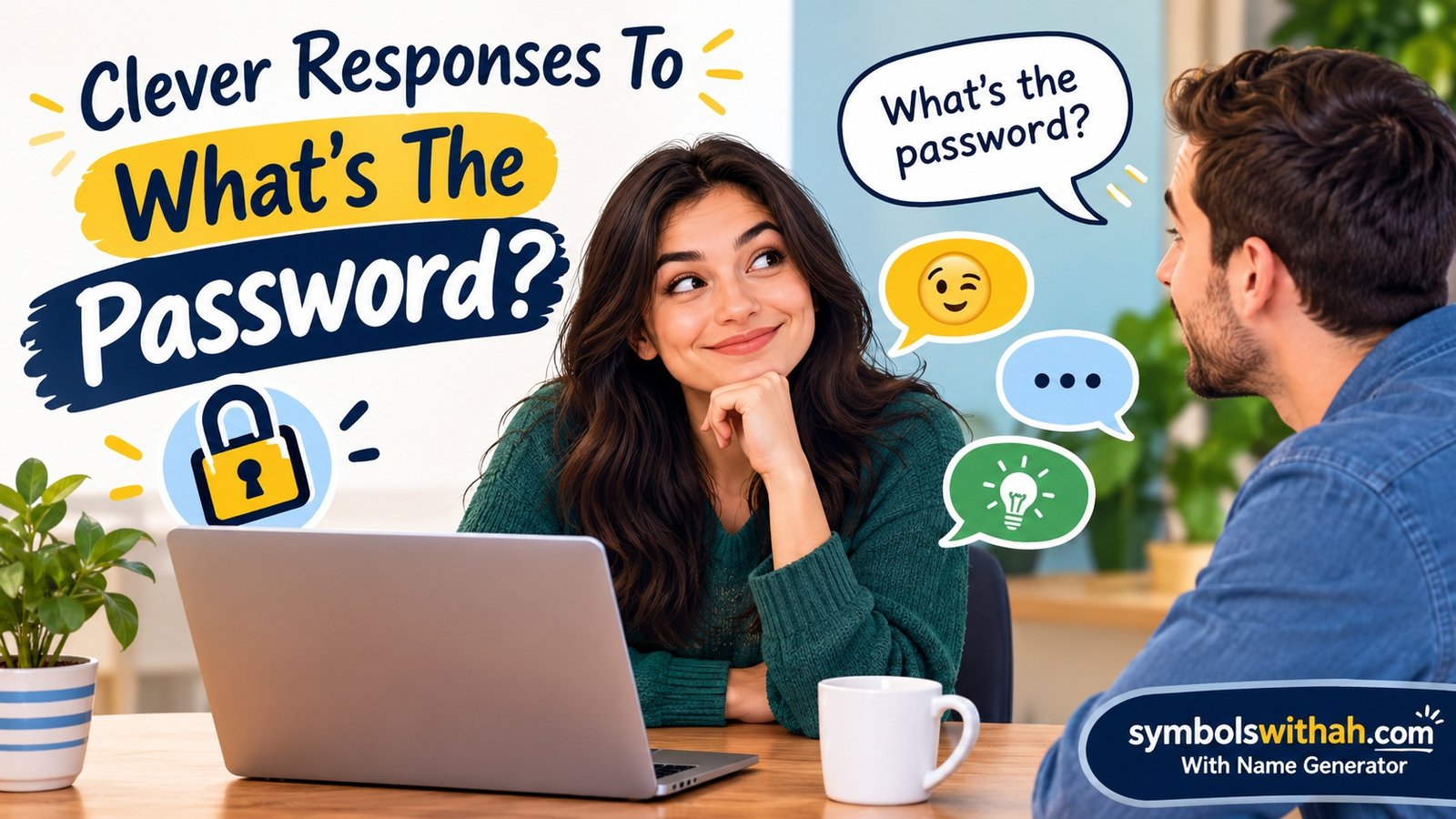
Asking “What’s the password?” can be a simple request, but with friends or someone you know well, it can also be an easy opening for a quick joke. Instead of giving the password straight away, you might tease them with a clever line that keeps the conversation light.
The best clever responses to “What’s the password?” depend on the situation. A funny comeback can work with a close friend, while a short and polite answer makes more sense with a guest, coworker, or someone you do not know well. The goal is to match the tone without making a simple question unnecessarily awkward.
Below, you’ll find natural replies for different situations, from funny and sarcastic comebacks to short, playful, flirty, and polite answers. Whether you want to make someone laugh or simply answer with a little personality, there’s a response that can fit the moment.
Read More: 25 Best Responses to “Happy New Year” That Sound Warm, Funny, and Natural
Clever and Funny Responses to “What’s the Password?”
When the question is casual, a little humor can make an ordinary exchange much more entertaining. These responses work especially well with friends, siblings, roommates, or anyone who already understands your sense of humor.
Meaning
These answers turn a straightforward request into a playful moment. Instead of immediately giving the password, you make the other person work for the answer—or at least laugh before getting it.
Tone
Funny, playful, casual, and slightly mischievous.
Example
Friend: What’s the password?
You: First, prove you’re worthy of the Wi-Fi.
Friend: Seriously, what is it?
You: That depends. Are you bringing snacks?
Best Use
Use these with friends and people who will understand that you’re joking. If someone genuinely needs the password urgently, do not drag the joke out too long.
Short Clever Replies
Sometimes the best comeback is only a few words. A short response is particularly useful when you’re texting or when the conversation is moving quickly.
Meaning
These replies keep things light without turning a simple question into a long exchange.
Tone
Casual, confident, witty, and direct.
Example
Friend: What’s the password?
You: Nice try.
Or:
Friend: Password?
You: Classified information.
Best Use
These work well in texts, group chats, casual conversations, and quick exchanges with friends.
Playful Responses That Make Them Guess
If you want to have a little fun, make the password sound like a secret that requires some detective work.
Meaning
You are pretending that access to the Wi-Fi or whatever requires the password is a privilege that must be earned.
Tone
Playful, teasing, and lighthearted.
Example
Friend: What’s the password?
You: Take a guess. Hint: it describes your personality.
Friend: “Amazing”?
You: Wrong. But I respect the confidence.
Best Use
This is ideal for close friends who enjoy teasing and back-and-forth humor.
Sarcastic Comebacks to “What’s the Password?”
A sarcastic answer can be hilarious when the relationship already includes playful roasting.
Meaning
The response deliberately treats an ordinary request as though it were a dramatic or highly classified matter.
Tone
Sarcastic, confident, and humorous.
Example
Friend: What’s the password?
You: Sorry, I signed an NDA.
Or:
Friend: Can I get the Wi-Fi password?
You: I’ll need three forms of identification first.
Best Use
Use these with friends or people who appreciate sarcasm. Avoid them with someone who may interpret your answer literally.
Clever Wi-Fi Password Responses
When someone specifically wants your Wi-Fi password, you can make the exchange more entertaining without refusing to help.
Meaning
These responses acknowledge what they need while adding a little personality to the conversation.
Tone
Friendly, humorous, and casual.
Example
Guest: What’s the Wi-Fi password?
You: The Wi-Fi demands a compliment first.
Guest: Fine. Your Wi-Fi is excellent.
You: Accepted.
Best Use
These are great when guests, friends, or family members are visiting your home.
Polite Responses When Someone Really Needs the Password
Not every “What’s the password?” needs a joke. If someone is genuinely trying to connect to your network, a straightforward response is usually the most considerate choice.
Meaning
You are being helpful instead of turning a practical request into a joke.
Tone
Polite, friendly, and direct.
Example
Guest: What’s the Wi-Fi password?
You: Sure, it’s written on the card beside the router.
Or:
Guest: Could I get the Wi-Fi password?
You: Of course. It’s [password].
Best Use
Use this approach with guests, coworkers, customers, family members, or anyone who may not appreciate sarcasm.
Quick tip: If you are unsure whether the person is joking, start with a simple answer rather than a sarcastic one.
Confident Responses to “What’s the Password?”
A confident comeback gives the impression that you are completely in control of the conversation.
Meaning
These replies playfully establish that the password is not something you hand over without a little ceremony.
Tone
Confident, witty, and teasing.
Example
Friend: What’s the password?
You: You have to earn premium access.
Friend: And how do I do that?
You: Start by saying something nice about the Wi-Fi.
Best Use
This style works best with friends and playful social situations.
Ridiculously Dramatic Password Replies
Sometimes making the situation sound far more serious than it actually is creates the funniest response.
Meaning
You exaggerate the importance of the password for comedic effect.
Tone
Dramatic, playful, and intentionally over-the-top.
Example
Friend: What’s the password?
You: I could tell you, but then the Wi-Fi council would have to erase your memory.
Or:
Friend: What’s the password?
You: That information is protected by ancient technology.
Best Use
Use these when the conversation is already relaxed and humorous.
Mysterious Responses to “What’s the Password?”
If you want your answer to sound intriguing, keep it vague enough to make the other person curious.
Meaning
Instead of giving the answer immediately, you make the password sound like a secret worth discovering.
Tone
Mysterious, playful, and clever.
Example
Friend: What’s the password?
You: It has been whispered only to the worthy.
Friend: Okay, mysterious one. What is it?
You: Fine. I’ll make an exception.
Best Use
This works especially well with friends who enjoy playful conversations.
Flirty Responses to “What’s the Password?”
If the question comes from someone you’re dating or flirting with, you can turn the password request into a playful opening.
Meaning
The answer adds a little romantic or teasing energy to an otherwise ordinary question.
Tone
Flirty, playful, confident, and light.
Example
Them: What’s the password?
You: You could ask nicely.
Them: Please?
You: Much better. I like that attitude.
Another option:
Them: What’s the password?
You: I was hoping you’d find an excuse to talk to me.
Best Use
Use flirty replies only when there is already mutual chemistry. They can feel awkward if the relationship is purely friendly or professional.
Cute Responses to “What’s the Password?”
A cute answer can keep the interaction warm without making the joke too sarcastic.
Meaning
These responses add charm and friendliness rather than trying to roast the person asking.
Tone
Cute, friendly, playful, and relaxed.
Example
Friend: What’s the password?
You: Say the magic words.
Friend: Please?
You: Correct. You may enter.
Best Use
These are suitable for friends, family, partners, and casual conversations.
Clever Responses When You Don’t Want to Give the Password
Sometimes you simply don’t want to share your password. You can set that boundary without sounding unnecessarily rude.
Meaning
These replies communicate that the password is private while keeping the tone light.
Tone
Firm, playful, and respectful.
Example
Person: What’s the password?
You: Nice attempt, but that one stays classified.
Or:
Person: Can I have your Wi-Fi password?
You: I keep my passwords private, but I can help you connect another way.
Best Use
Use the first option with friends when you’re joking. Use the second when you genuinely want to maintain a privacy boundary.
Better choice: If the password protects personal accounts rather than guest Wi-Fi, don’t feel pressured to share it just because someone asks.
Funny Responses for Friends
Close friends give you more freedom to be ridiculous. A response that would sound strange with a stranger can be hilarious between people who know each other well.
Meaning
These answers use your existing friendship as the foundation for the joke.
Tone
Friendly, teasing, humorous, and informal.
Example
Friend: What’s the password?
You: The same thing it has always been: “Bring snacks.”
Friend: Seriously?
You: You should’ve arrived prepared.
Best Use
Perfect for close friends, roommates, siblings, and group hangouts.
Clever Text Responses to “What’s the Password?”
Text messages are perfect for short, unexpected replies because you can create a little suspense.
Meaning
These answers turn a routine text into a quick joke without requiring a long conversation.
Tone
Casual, witty, and concise.
Example
Them: What’s the password?
You: Password123.
Them: No way.
You: Congratulations. You have discovered the least secure joke on the internet.
Best Use
Use these in texts, Messenger conversations, Snapchat, group chats, or casual DMs.
Responses That Pretend the Password Is Obvious
A playful way to answer is to act as though the other person should have known it already.
Meaning
You jokingly suggest that the password is so obvious that asking for it was unnecessary.
Tone
Teasing, humorous, and confident.
Example
Friend: What’s the password?
You: Obviously, “I should have asked sooner.”
Friend: That can’t actually be it.
You: You had one job.
Best Use
This works best with people who enjoy harmless teasing.
Witty One-Liners for “What’s the Password?”
If you want something that sounds quick and polished, a clever one-liner can do the job.
Meaning
The response creates humor in a single sentence without requiring much explanation.
Tone
Witty, casual, and confident.
Example
Friend: What’s the password?
You: It’s a secret, but apparently not a very good one.
Other options include:
- “You’ll have to pass the vibe check first.”
- “That’s above your Wi-Fi clearance.”
- “I’ll tell you after the security meeting.”
- “The password knows who is worthy.”
- “I charge one compliment per connection.”
- “Let me check whether you’re on the guest list.”
- “It’s protected by extremely questionable security.”
Best Use
These are useful when you need a quick comeback for a conversation, text, or social media exchange.
Responses That Turn the Question Back on Them
Sometimes the funniest move is to answer the question with another question.
Meaning
Instead of immediately providing the password, you create a playful challenge.
Tone
Teasing, conversational, and mischievous.
Example
Friend: What’s the password?
You: What do you think it should be?
Friend: “Free Wi-Fi”?
You: Bold. Not correct, but bold.
Best Use
This works especially well when the other person enjoys conversational banter.
Professional Responses to “What’s the Password?”
In a workplace or business setting, humor may not be the best choice. A clear answer keeps things efficient and avoids unnecessary confusion.
Meaning
The goal is to answer the practical question while maintaining a professional tone.
Tone
Professional, polite, and direct.
Example
Coworker: Do you know the Wi-Fi password?
You: Yes. I’ll send it to you privately.
Or:
Visitor: Could I have the guest Wi-Fi password?
You: Certainly. The guest network details are on the information sheet.
Best Use
Use these at work, during professional meetings, in offices, or when communicating with customers and visitors.
Playful Responses for Parties and Gatherings
At a party, the password question can become part of the social atmosphere.
Meaning
These responses keep the mood lively while still helping the guest get connected.
Tone
Social, humorous, welcoming, and relaxed.
Example
Guest: What’s the Wi-Fi password?
You: Welcome to the party. You’ve unlocked level two.
Guest: And level three?
You: That’s where the snacks are.
Best Use
Great for house parties, dinners, casual gatherings, and celebrations.
Responses for Someone Who Keeps Asking
If someone has already asked several times, you can acknowledge the repetition with humor.
Meaning
The joke comes from the fact that the same question keeps coming back.
Tone
Teasing, mildly sarcastic, and playful.
Example
Friend: What’s the password?
You: Still the same answer as thirty seconds ago.
Friend: I forgot.
You: Your Wi-Fi privileges are under review.
Best Use
Use this with someone you know well. If the person genuinely forgot, give them the password afterward rather than letting the joke become annoying.
Extra-Clever Responses When You Want to Be Unexpected
An unexpected answer can be more memorable than a predictable joke.
Meaning
These responses take the conversation in an amusing direction instead of giving the obvious answer.
Tone
Creative, witty, playful, and surprising.
Example
Friend: What’s the password?
You: The password is the friends we made along the way.
Or:
Friend: What’s the password?
You: I don’t know. I’m just the Wi-Fi’s emotional support person.
Best Use
These are best for relaxed conversations where the goal is simply to make someone laugh.
How to Choose the Right Response
The funniest response isn’t always the best response. Think about who is asking, why they are asking, and what kind of relationship you have with them before choosing a comeback.
Meaning
Choosing a response based on context prevents a playful joke from accidentally sounding rude, dismissive, or inappropriate.
Tone
Context-dependent.
Example
Coworker: What’s the office Wi-Fi password?
You: I’ll send it to you privately.
That’s more appropriate than:
You: First, prove your Wi-Fi worthiness.
Best Use
Use this approach whenever you’re uncertain about the person’s mood or expectations.
Quick tip: If you’re not sure, choose a friendly and simple answer first. Humor works best when both people understand that you’re joking.
Frequently Asked Questions
What is a clever response to “What’s the password?”
A clever response can be something playful like, “You’ll have to pass the vibe check first,” or “That information is classified.” Choose a response that matches your relationship with the person.
What is a funny response to “What’s the password?”
Try something like, “I could tell you, but then I’d have to pretend to erase your memory.” This works best with friends who enjoy exaggerated jokes.
How can I respond politely to “What’s the password?”
If the person genuinely needs access, simply give them the password or tell them where they can find the guest network details. A direct response is usually best in professional or unfamiliar situations.
What is a good short reply to “What’s the password?”
Short options include “Nice try,” “Classified,” “Guess first,” or “You wish.” Pick one based on how playful the conversation is.
Can I use a flirty response to “What’s the password?”
Yes, if the conversation already has a mutual flirty tone. Something like “You could ask me nicely” can work when there is established chemistry, but it may feel inappropriate in a purely friendly or professional interaction.
Should I joke when someone asks for a password?
Only if the situation is suitable for humor. If someone genuinely needs the password, especially at work or as a guest, answer clearly rather than making them work through a long joke.
Conclusion
The best response to “What’s the password?” depends less on having the cleverest line and more on reading the situation correctly. A sarcastic comeback can be hilarious with a close friend, while a simple answer is much better for a coworker or guest. If you’re texting someone you know well, a short playful reply can keep the conversation fun without making it complicated.
The safest approach is to match the other person’s energy. Keep it funny when the moment invites humor, keep it polite when the situation calls for clarity, and keep it respectful when a password is genuinely private. The right response should sound like something you would naturally say—not something you had to force into the conversation.